

Cats and carbs

A cat is a carnivore. Its physique is made to catch, tear up and digest its prey. Wild cats are fine living off their prey alone. When left to their own devices, they will steer clear of any berries, potatoes and grains. These foods would be pointless: their system isn’t fit to digest them.
At some point, we – humans – domesticated the wild cat. At first to catch mice, rats and other vermin, and later for its company as well. As a mouse hunter, our cat was still getting enough meat on its plate. But the social cat got access to other sources of food, sometimes fresh meat as well as increasingly often ready-made dry cat food; pellets containing meat, plus other ingredients that a wild cat would never eat. How good or bad is this?
Nutritional composition
A bit of background information: humans and animals alike can extract energy from proteins, fats and carbohydrates.

Food consists of these three energy sources plus fibres*, crude ash and fluids. Not all elements are present in all foods: for example, meat does not contain any carbohydrates. All the separate elements put together will always make up 100%.

Cats don’t eat carbs, right?
Meat doesn’t contain any carbs, plant-based foods do. A cat is a carnivore and gets its energy from the proteins and fats in its prey. But to say that a cat cannot digest the carbs in plant-based foods would be a hasty conclusion and partially untrue.
It is correct to say that a cat cannot digest a pea or a raw potato. But humans face the same predicament. So we boil, fry, steam and process foods in all kinds of ways to make sure we can eat and digest them. The exact same principle applies to our dry food: the carbs (starch) in our dry foods are ‘unlocked’ by heat which allows cats to digest it. This has been studied, of course**, and as it turns out on average cats can use 95% of the unlocked carbs for energy.
Why not 100% meat?
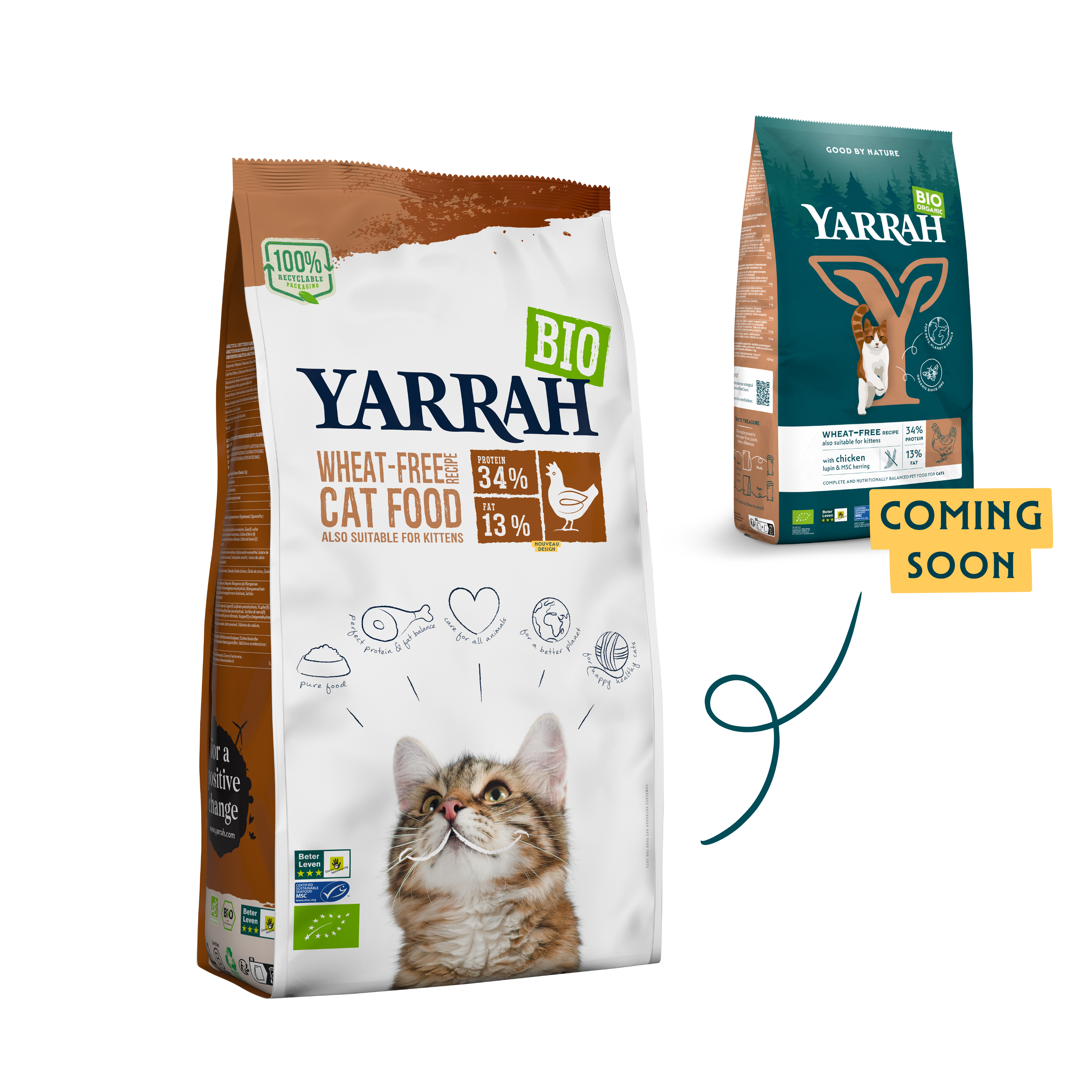
1 kg of dry food requires about 1.2 kg chicken. The chicken is dried and then added to the mix. Meat alone doesn’t make for very crunchy pellets, so we need a source of starch. Cat food Dry with Chicken and Cat food Dry with fish contain wheat as a source of starch. The grain-free variety is made with tapioca and peas instead.
Would we be able to add more meat? Sure, but your cat gets more than enough energy from the three sources available in our food: proteins, fats and carbohydrates. And considering the public debate about excessive meat consumption and its negative impact on the climate, it wouldn’t be responsible to add more meat than necessary.
Conclusion
From a physical point of view, a cat is a carnivore that gets its energy from proteins and fats. In addition, a cat can extract energy from carbohydrates, as long as they are ‘unlocked’. If you still want to feed your cat fresh meat, do make sure to use organic meat and add enough vitamins and minerals to the overall diet of your animal.
* Officially fibres are also part of the carbohydrate category, but fibres aren’t absorbed by the body. They serve to support the intestines. That is why they are mentioned separately on product labels.
** Research: Effects of six carbohydrate sources on diet digestibility and postprandial glucose and insulin response in cats, L.D. de-Oliveira, A.C. Carciofi, M.C.C. Oliveira, R.S. Vasconcellos, R.S. Bazolli, G.T. Pereira and F. Prada.


Organic cat food: 5 benefits for your cat and the planet
Cat

Renewed chewsticks for dogs and cats less beef more impact
Our world

